Well usually we know how to solve problems like:
x = 3^4
which will equal 81.
We know how to also solve problems when the unknown is alone:
(3)^3 = (x^1/3)^3
which will equal; x = 3^3 = 27
We know how to solve problems where even the base is unknown:
4 = x^2
which will equal to -2,2.
What we didn't know is this;
100 = 10^x , but this problem is easy, x would have to equal 2 in order for this to be true.
this problem is where the unknown is actually the exponent.
Solve for x;
2^11 = 2^x
which will equal 11.
When the bases are the same, the exponents have to be equal as well.
Solve for x:
2^x-3 = 4
2^x-3 = 2^2
x-3 = 2
+3=+3
_____________
Final Answer, x=5
Monday, January 21, 2013

Thursday, January 10, 2013
Aim: How do we multiply and divide rational expressions ?
Multiplying and dividing may seem difficult, but when using them to solve rational expressions, it can be a lot easier. First, we start out by factoring out all of the numerators and the denominators so we can make things much easier for us. Then we get to cancel out all of the common factors to simplify the expressions. Lastly we have to multiply the remaining factors in the numerator & the denominator. We can find out the answer with these simple steps.
Problem:
2x +10x + 12x x + 7
____________ * _____
2x + 10x x² − 9
↓
2x(x +5x +6) x + 7
__________ * ________ (Factor it Out)
2x(x + 5) (x+3)(x−3)
↓
2x(x+2)(x+3) x + 7
____________ * _______ (Cross Out)
2x(x + 5) (x+3)(x−3)
↓
(x+2) (x +7) x² +9x + 14 (Multiply Remaining Factors)
______ * ______ = ___________
↓
x² +9x + 14
__________ (x cannot equal; 0, 3,−3,−5)
x² +2x − 15
DIVIDING:
First you start out by using KCF (Keep, Change, Flip) which is the multiplication of reciprocal.
Problem :
x + 7 x² + 9x + 14 x + 7 3x² - 9x
____ / ___________ KCF _____ * __________
x² − 9 3x² − 9x x² − 9 x² + 9x + 14
Step 2: Factor out everything that needs to be factored.
x + 7 3x(x − 3)
_________ * ________
(x− 3)(x+3) (x+7)(x+2)
Step 3: Cancel out the common factors
x + 7 3x(x − 3)
_________ * ________
(x− 3)(x+3) (x+7)(x+2)
Step 4: Multiply the remaining factors of the numerator & denominator.
3x 3x
_________ * ____________
(x+2)(x+3) x² + 5X + 6
3x
__________ (x cannot equal; 0,−2,3,−7,−3)
x² + 5X + 6
http://www.mathwarehouse.com/algebra/rational-expression/how-to-multiply-divide-rational-expressions.php
Problem:
2x +10x + 12x x + 7
____________ * _____
2x + 10x x² − 9
↓
2x(x +5x +6) x + 7
__________ * ________ (Factor it Out)
2x(x + 5) (x+3)(x−3)
↓
2x(x+2)(x+3) x + 7
____________ * _______ (Cross Out)
2x(x + 5) (x+3)(x−3)
↓
(x+2) (x +7) x² +9x + 14 (Multiply Remaining Factors)
______ * ______ = ___________
(x+5) (x−3) x² +2x − 15
↓
x² +9x + 14
__________ (x cannot equal; 0, 3,−3,−5)
x² +2x − 15
DIVIDING:
First you start out by using KCF (Keep, Change, Flip) which is the multiplication of reciprocal.
Problem :
x + 7 x² + 9x + 14 x + 7 3x² - 9x
____ / ___________ KCF _____ * __________
x² − 9 3x² − 9x x² − 9 x² + 9x + 14
Step 2: Factor out everything that needs to be factored.
x + 7 3x(x − 3)
_________ * ________
(x− 3)(x+3) (x+7)(x+2)
Step 3: Cancel out the common factors
x + 7 3x(x − 3)
_________ * ________
(x− 3)(x+3) (x+7)(x+2)
Step 4: Multiply the remaining factors of the numerator & denominator.
3x 3x
_________ * ____________
(x+2)(x+3) x² + 5X + 6
Final Answer
__________ (x cannot equal; 0,−2,3,−7,−3)
x² + 5X + 6
http://www.mathwarehouse.com/algebra/rational-expression/how-to-multiply-divide-rational-expressions.php
Aim: How do we solve problems with the rational expression operations?
For starters, Rational Expressions can be defined as fractions that have variables in their denominator.
Multiplying Rational Expressions: We should begin by searching for things that can be eliminated otherwise known as factoring it out. Once you have that done, you can start to divide out the common factors and simplify the expression. For Example ;

-> You look to see if you can factor anything out.
Nothing can be factored out just yet.
-> Divide the common factors.
Multiplying Rational Expressions: We should begin by searching for things that can be eliminated otherwise known as factoring it out. Once you have that done, you can start to divide out the common factors and simplify the expression. For Example ;
-> You look to see if you can factor anything out.
Nothing can be factored out just yet.
-> Divide the common factors.
=

-> Simplify.
Final Answer will be

Sunday, November 18, 2012
Aim: How do we use imaginary numbers?
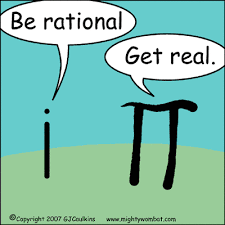
Finding out the meaning of imaginary numbers can be complicated but as long as you know what i represents an imaginary number you'll be alright.
We define i= √-1 , also called the imaginary unit. We call i the solution to the equation ; i²+1=0 or i²=-1.
Simplyfying Imaginary Numbers for any Number s,
√-s = i√s
Example : √-9 = √-1√9
= i√9
which equals to 3i
What is the value of i² ? -1
i³ = i² * i = -1 * i = -i
and so on .
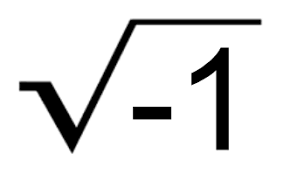
We define i= √-1 , also called the imaginary unit. We call i the solution to the equation ; i²+1=0 or i²=-1.
Simplyfying Imaginary Numbers for any Number s,
√-s = i√s
Example : √-9 = √-1√9
= i√9
which equals to 3i
What is the value of i² ? -1
i³ = i² * i = -1 * i = -i
and so on .
Sunday, October 28, 2012
How do we recognize functions?
Recognizing functions is simple, first we have to know the definition of a function.
A Function is a relation that assigns exactly one output (known as the range) value for each input (know as the domain) value.
We recognize functions by making sure the same input value "(x)" is NEVER repeated. We may use
brackets -> { }
Tables, graphs, or mappings.
Some of the characteristics of a function from set A to set B are:
1. Each element of A must be matched with an element B.
2. Some elements of B may not be matched with any elements of A.
3. Two or more elements of A may be matched with the same element of B.
4. An element of A (the domain) cannot be matched with two different elements of B.
Example:
Function: 2x^2+3x+1, we call y a function of x, and use the notation f(x) to represent y.
F(x)= 2x^2+3x+1 .
f(x)=x^2-4x ; Find the following...
A. f(-3)
f(-3)= -3^2 -4(-3)
9-12=-3Source: Class notes.
Subscribe to:
Posts (Atom)